
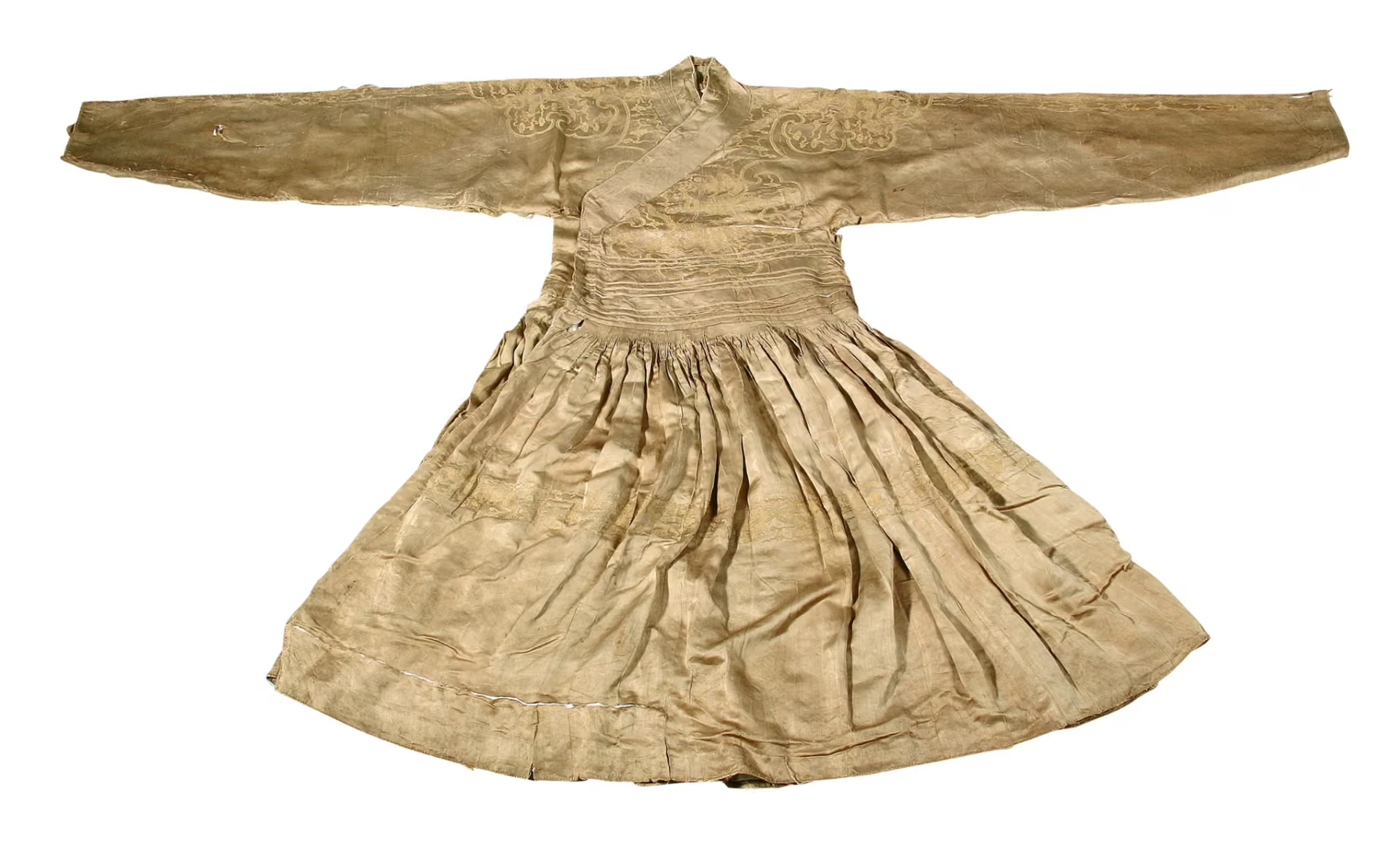
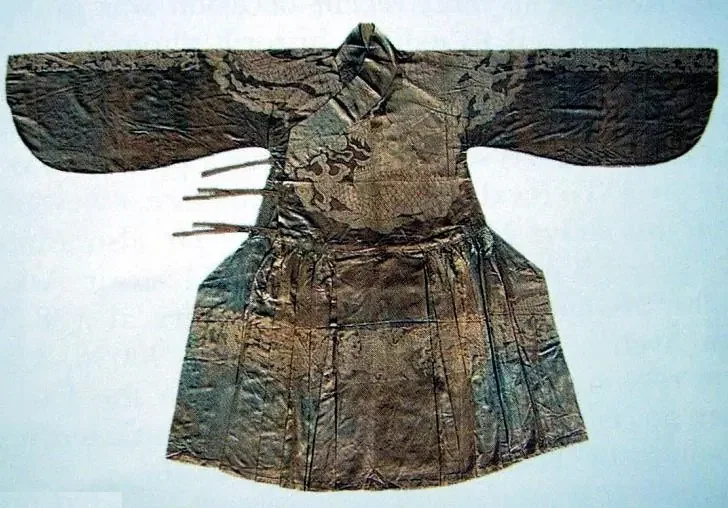
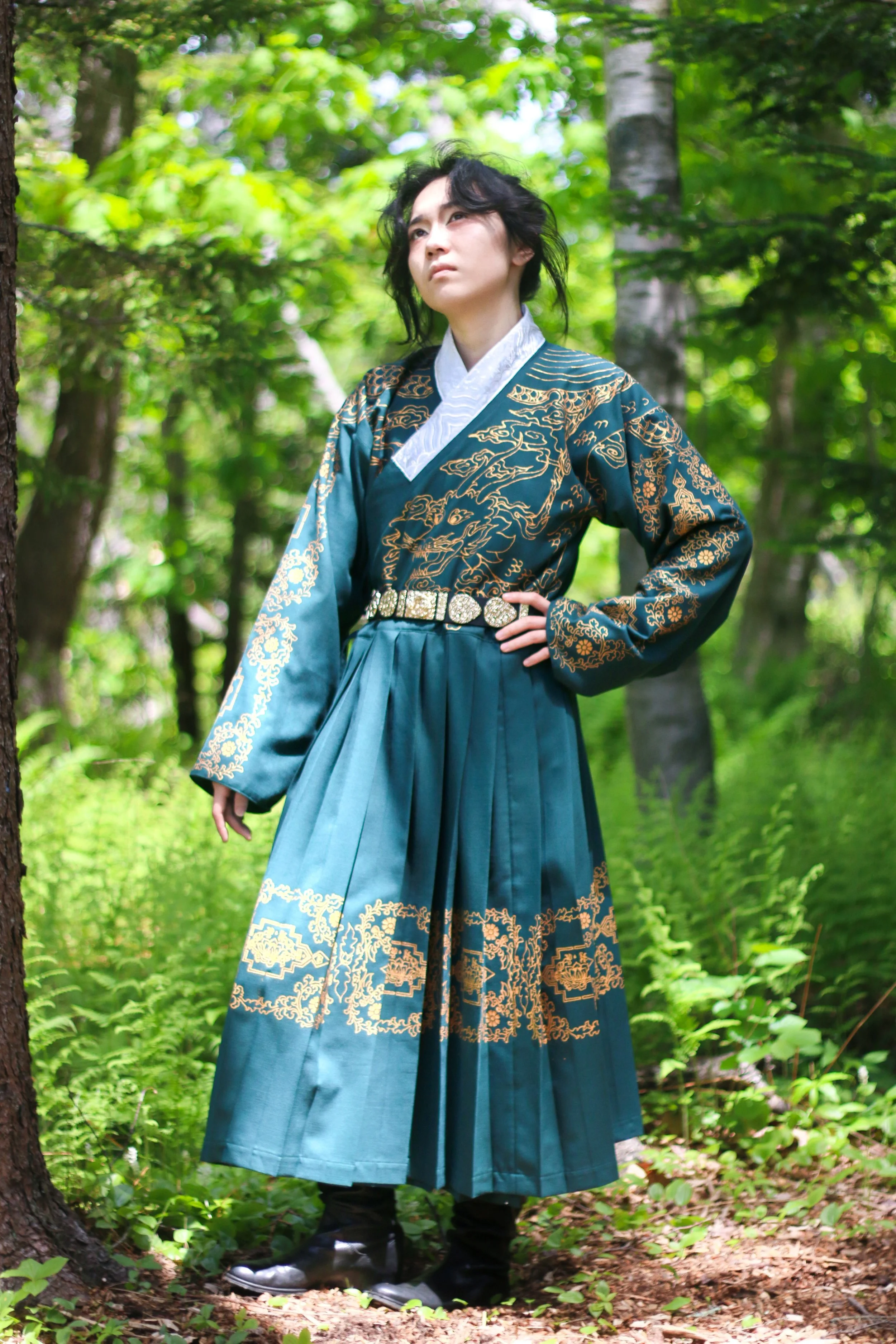
The tieli was adapted from the Mongol terlig, a garment designed for horseback archery and mobility. The tieli is a crossed-collar men’s robe with a pleated skirt worn in the Yuan Dynasty through the Ming Dynasty. The length of the hem could range from knee-length to ankle-length. The sleeves of the tieli were originally straight and narrow, to not obstruct mobility, but those wearing the tieli in a ceremonial or court setting sometimes sported wider curved pipa-style sleeves. In line with its origin as a utilitarian garment, the tieli was often constructed with a collarguard, designed to be replaced when it became soiled or worn-out. The tieli can be worn as an outer layer, but it can also be worn beneath an overcoat such as a zhaojia or yuanlingpao. The tieli is typically cinched at the waist with a leather belt.
Tieli worn for auspicious occasions such as festivals and ceremonies by individuals of very high rank would be made from silk and decorated along the collar, sleeves, and skirt. A yúnjiān (“cloud collar”; 云肩) pattern would be embroidered across the front and back of the shoulders. Tōngxiùlán (“sleeve band”; 通袖襕) designs would extend along the top side of the arm from the yunjian to the wrist. Xīlán (“knee band”; 膝襕) patterns were woven in a straight band across the pleated skirt over the knees.
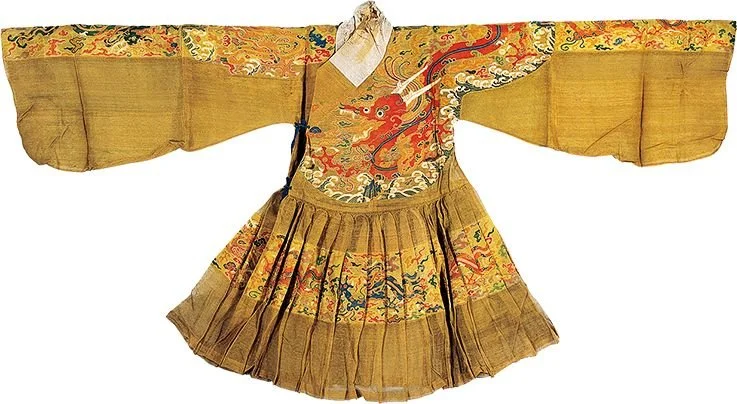
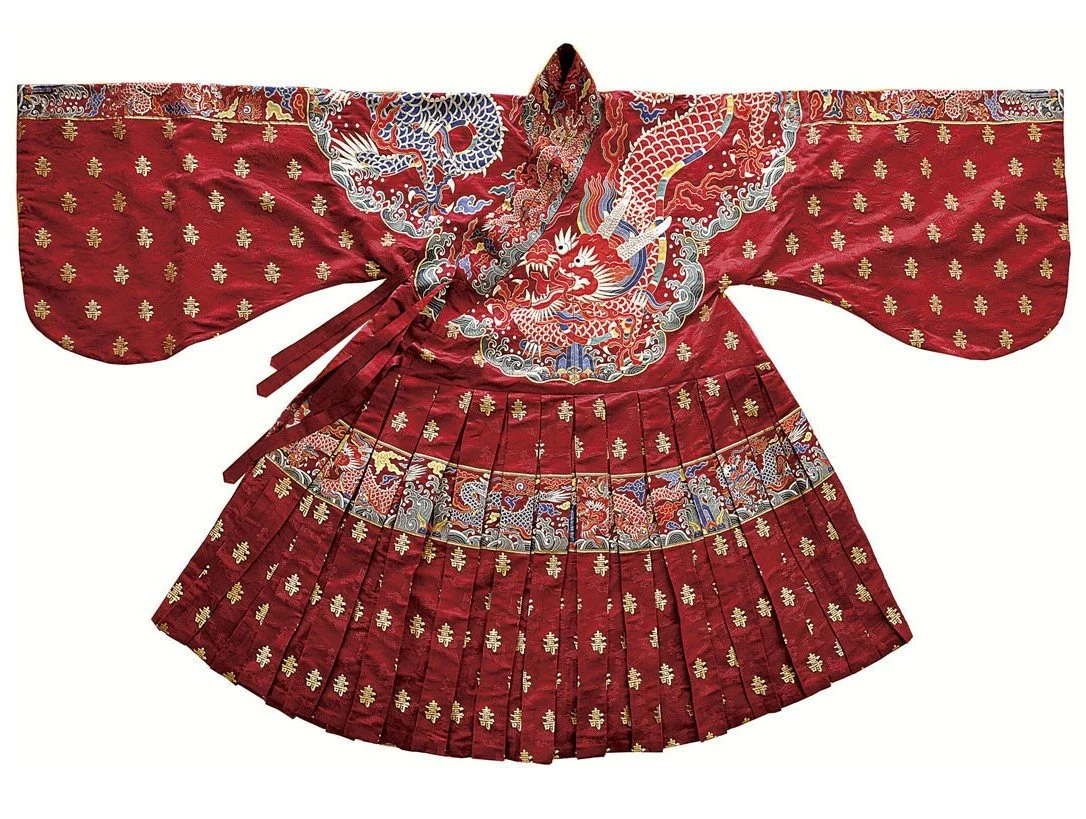
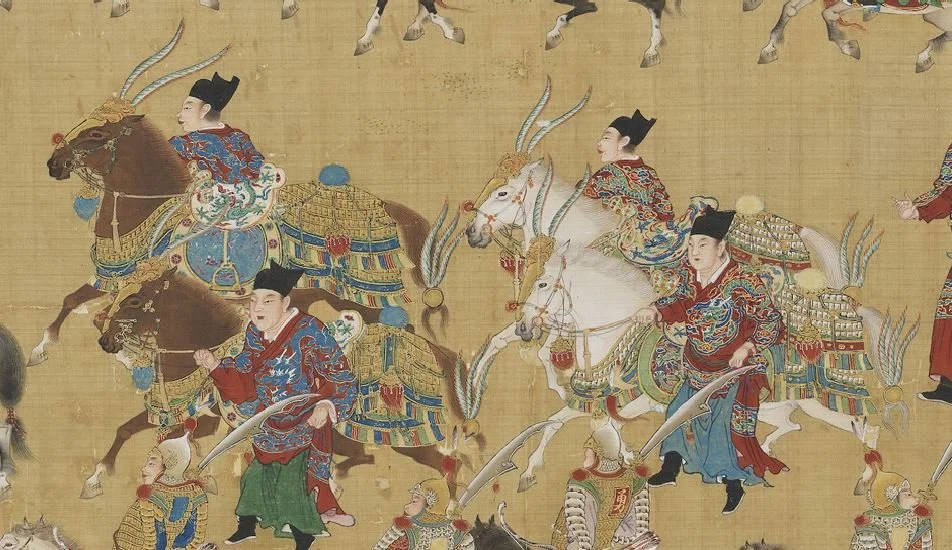
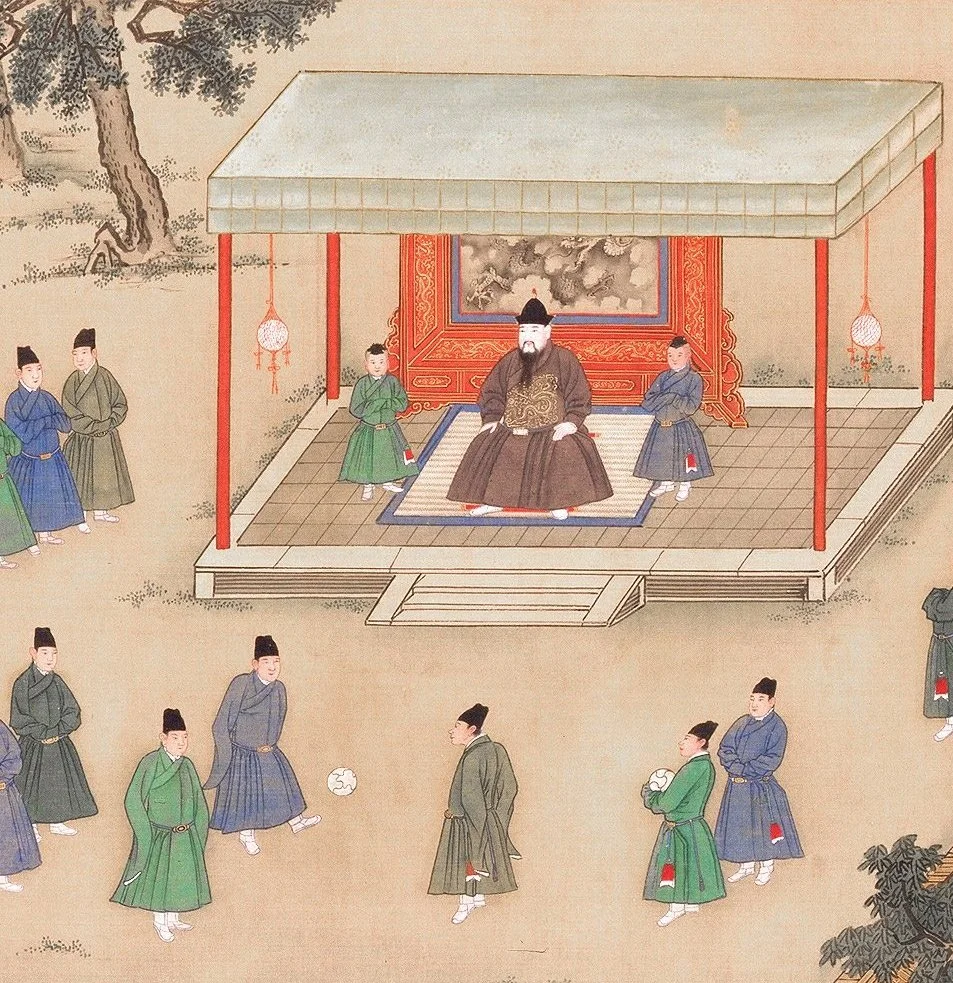
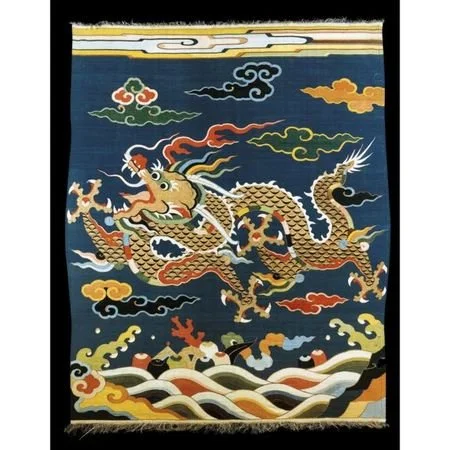
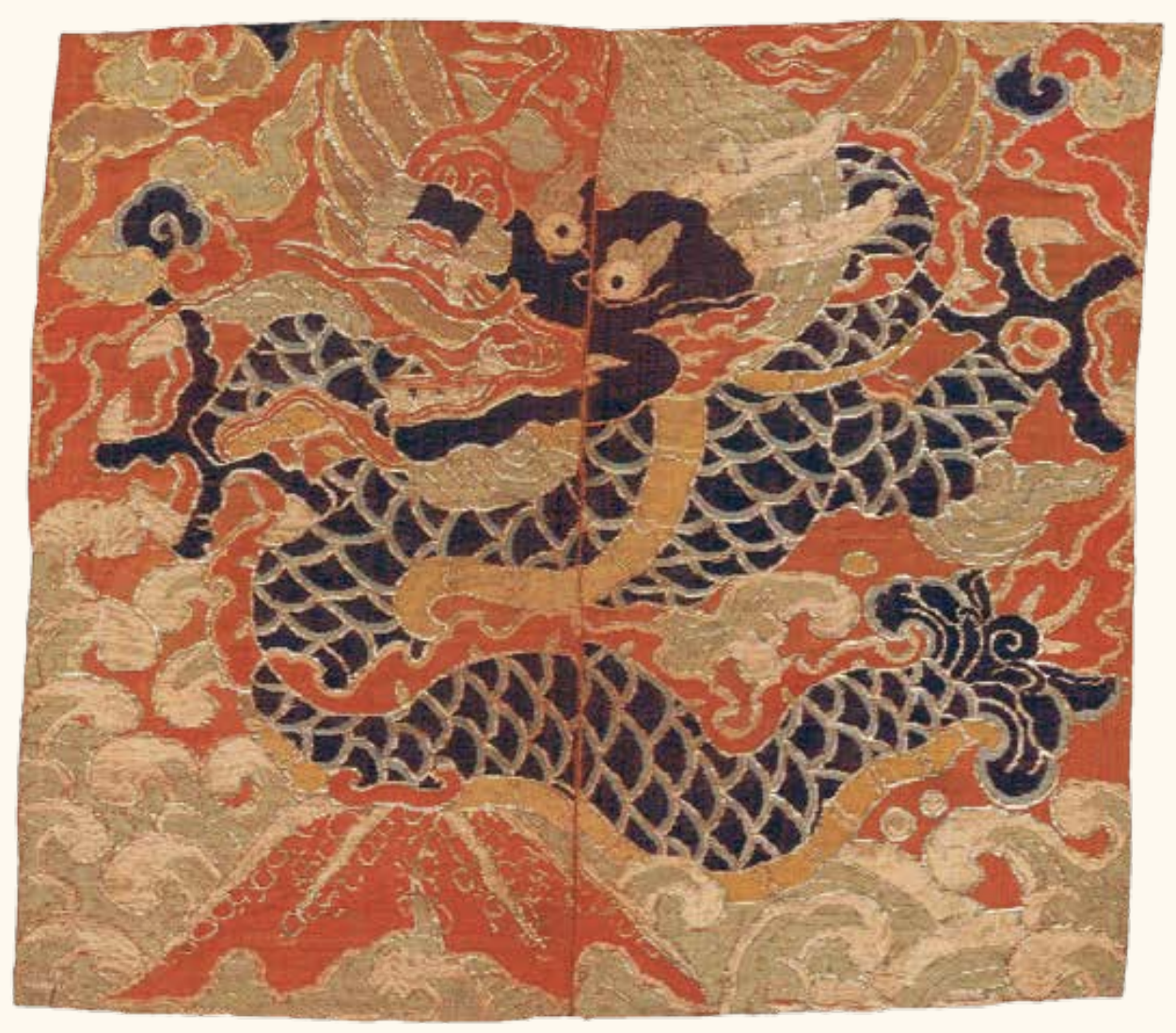
A particularly exclusive form of these ceremonial clothes were known as cìfú (赐服) and could only be personally awarded by the emperor. Cifu were decorated with 4-clawed (or hooved in the case of the qilin) dragon-like creatures and could be broken down into categories with the highest honor being mǎngfú (蟒服), decorated with a python design; the second highest honor being fēiyúfú (飞鱼服), decorated with a flying fish design; the third highest honor being dòuniúfú (斗牛服), decorated with a fighting bull; and the 4th highest honor being qílínfú (麒麟服), decorated with a qilin. The python symbolized nobility, second only to the dragon. The main way to distinguish the python from the dragons worn by the imperial family is that the python has only 4 claws on each foot, while true dragons have 5 claws on each foot. The flying fish originated from Indian mythology and symbolized the arrival of good omens and prosperity throughout the world. The flying fish would eventually lose its wings in designs, and become nearly identical to the python. The easiest way to distinguish the flying fish from the python is by its split fish tail, rather than a spikey dragon tail. The fighting bull derived from the constellations and was a symbol of luck, and could be distinguished from the python by its curved bull horns, rather than straight deer-like horns. The qilin symbolized peace and longevity, and could be distinguished by its hooves and lion-like tail. The honor of wearing cifu was generally only awarded to the jǐnyīwèi (“embroidered uniform guard”; 锦衣卫) who acted as the emperor’s personal guard and secret police, princes, marquises, high ranking court officials, or eunuchs attending directly to the emperor. Cifu robes were most commonly red, especially for the jinyiwei, but could also be yellow symbolizing the imperial power of the royal family, black symbolizing the solemnity for ritualistic occasions, or blue/green symbolizing scholarship and tranquility. Cifu would continue to be worn into the Qing Dynasty, though the classic pleated skirts of the tieli would no longer be used as the garment base.
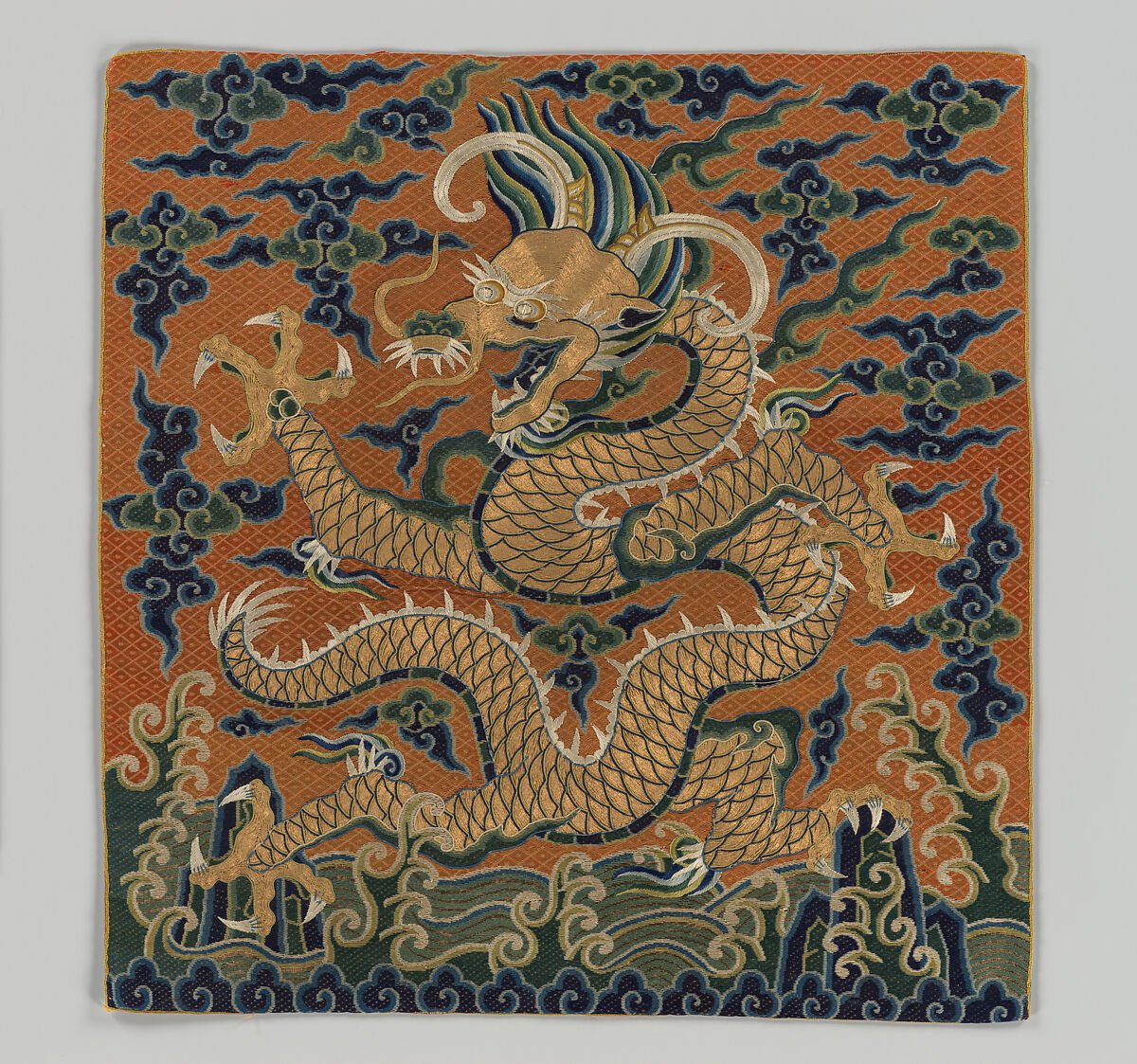
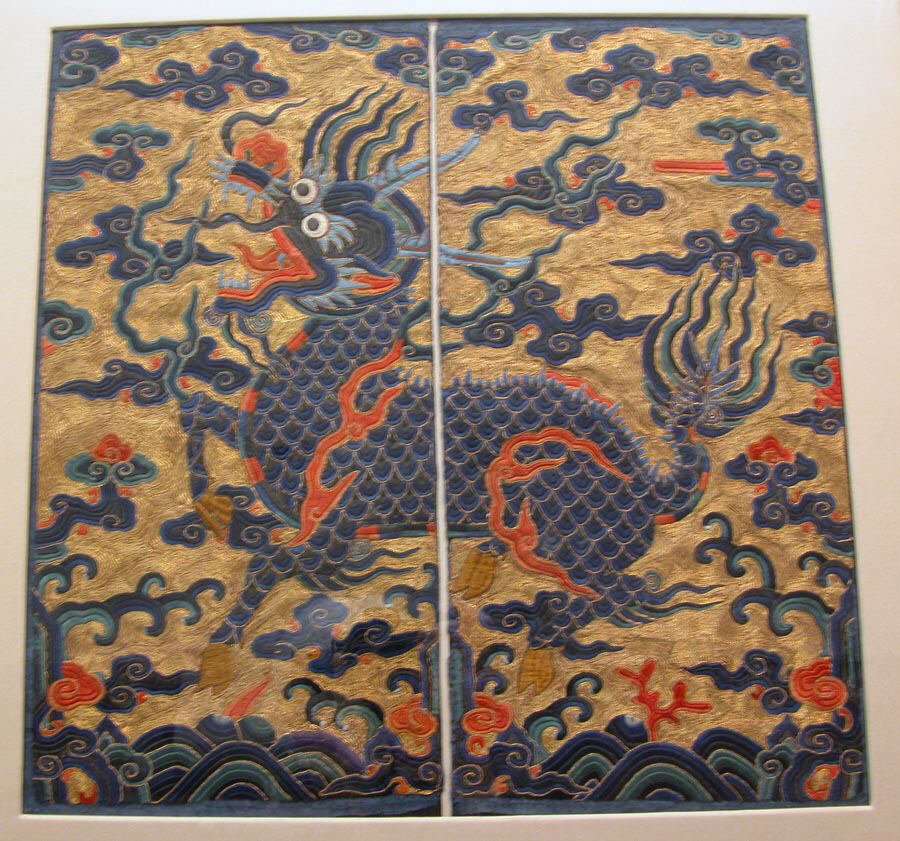
The tieli is very similar to the yìsǎn (曳撒), but there are a few key differences made in accordance with Ming fashion trends. Firstly, the tieli pleats are regularly spaced and traditionally made by evenly gathering the fabric at the waist. However, the yisan pleats are irregularly spaced with a wide panel in the center front and center back in the mamianqun skirt style predominant in the Ming Dynasty. Secondly, the tieli skirt does not have any side slits, whereas the yisan has side slits with overlapping panels called bai to cover the slit openings, again in the predominant style of Ming men’s robes. The yisan was favored by members of the Ming court and military men for the way its silhouette both embodied martial pragmatism and courtly elegance. Yisan worn for auspicious occasions could also be decorated with the yunjian, tongxiulan, and xilan designs.
Sew Your Own
Interested in making your own tieli? Use “The General” hanfu sewing pattern (includes tieli and zhaojia patterns).
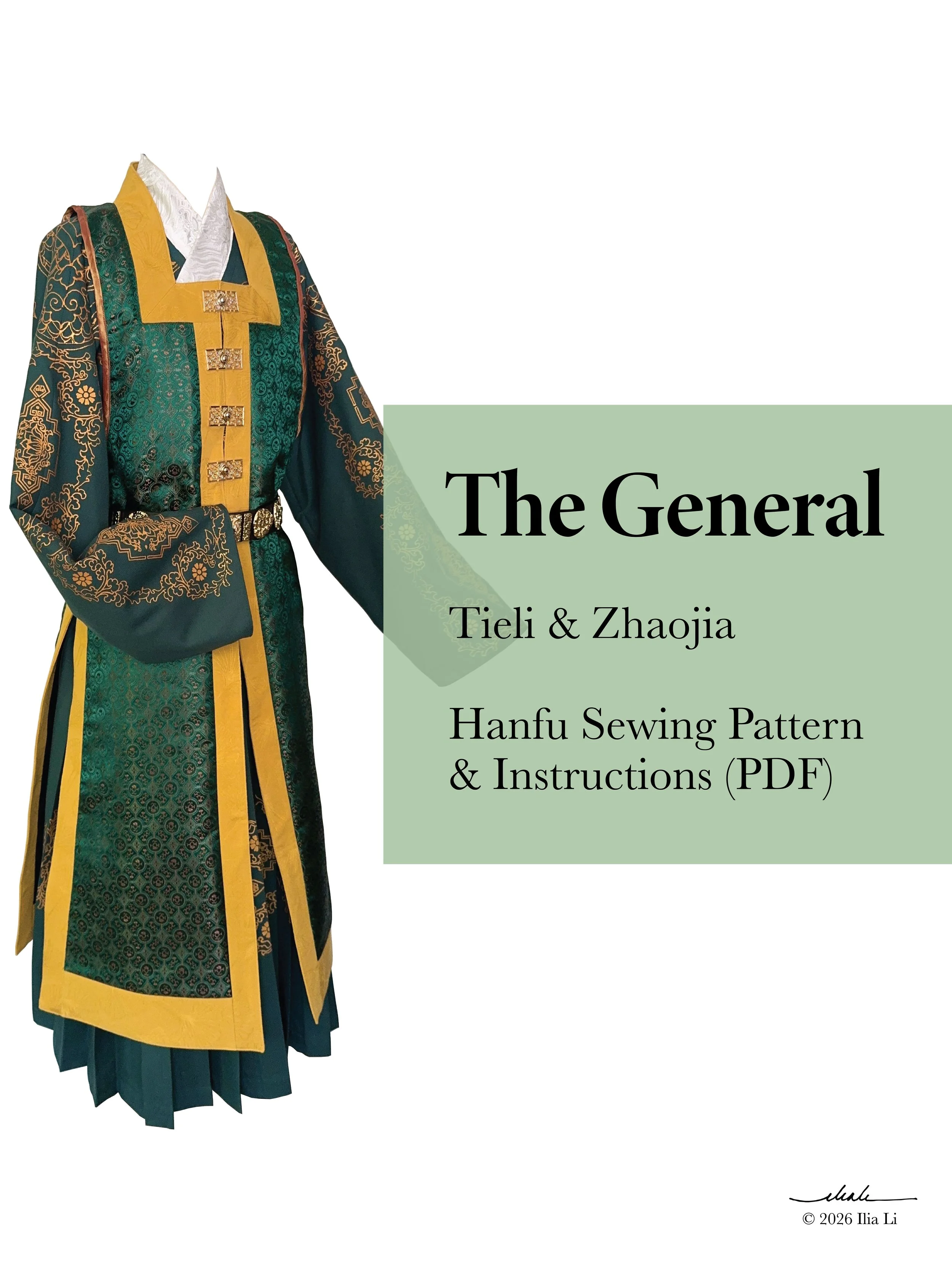
Looking for a Hanfu sewing pattern? Making a wuxia, xianxia, or danmei cosplay or Chinese historical reenactment costume of the Ming Dynasty military? Want a pattern that provides info on how to properly wear Hanfu and historical considerations like sleeve length and fabric choices? I have made just the pattern for you! This pattern includes 2 garments—a tieli and zhaojia—which can be worn layered together or separately. This pattern was inspired by the flying fish robes (feiyufu) worn by the Embroidered Uniform Guard (jinyiwei) in Ming Dynasty China.
This digital download includes:
Printable sewing pattern & fully illustrated sewing instructions for 2 garments: tieli & zhaojia
Printable patterns are compatible with US Letter, A4, and A0 paper
4 unisex sizes covering approximately US men’s XS-L or women’s XS-XXL and instructions on how to resize your pattern.
See size chart image for detailed measurements
Instructions on how to wear Hanfu
Historical considerations for fabrics, colors, motifs, and fit
Estimated yardage and sample cutting layouts
Note that I pattern in metric, so the standard seam allowance is 1 cm (3/8 in). Information to alter the seam allowance is provided
When you purchase this pattern, a checkout page will open containing a link to the digital download that will last for 24 hours. You will also receive an email with the same link. The download is a zip file which you will need to unzip to access the PDFs of the printable patterns and instructions. Please make sure to provide your correct email address so that the digital download is delivered to you successfully and remember to download it within 24 hours of delivery. To use the digital pattern, print out the pattern PDFs at 100% scale, tape together the numbered grid of pages, and then cut out the pattern pieces.
Note that this pattern is to be used for your personal use only. Commercial use and redistribution are not permitted.
Sources Consulted (photo sources listed in image captions):
5000 Years of Chinese Costume by Xun Zhou
Hanfu: A Visual Primer of Historical Han Chinese Attire by the Northern California Hanfu Association
Traditional Chinese Clothing: Costumes, Adornments & Culture by Shaorong Ya
Semantic Function of Dragon Patterns in Ming Dynasty Clothing by Lei Cheng & Siti Rohaya Yahaya
衮衣红耀天机锦——明代服饰中的龙纹与象龙纹样 by 董进
